The Biomechanics of the "Sitting Executive"

How Prolonged Desk Work Alters the Kinetic Chain, and the 5-Minute Structural Reset.
By Leo Davis | The MYOS Index
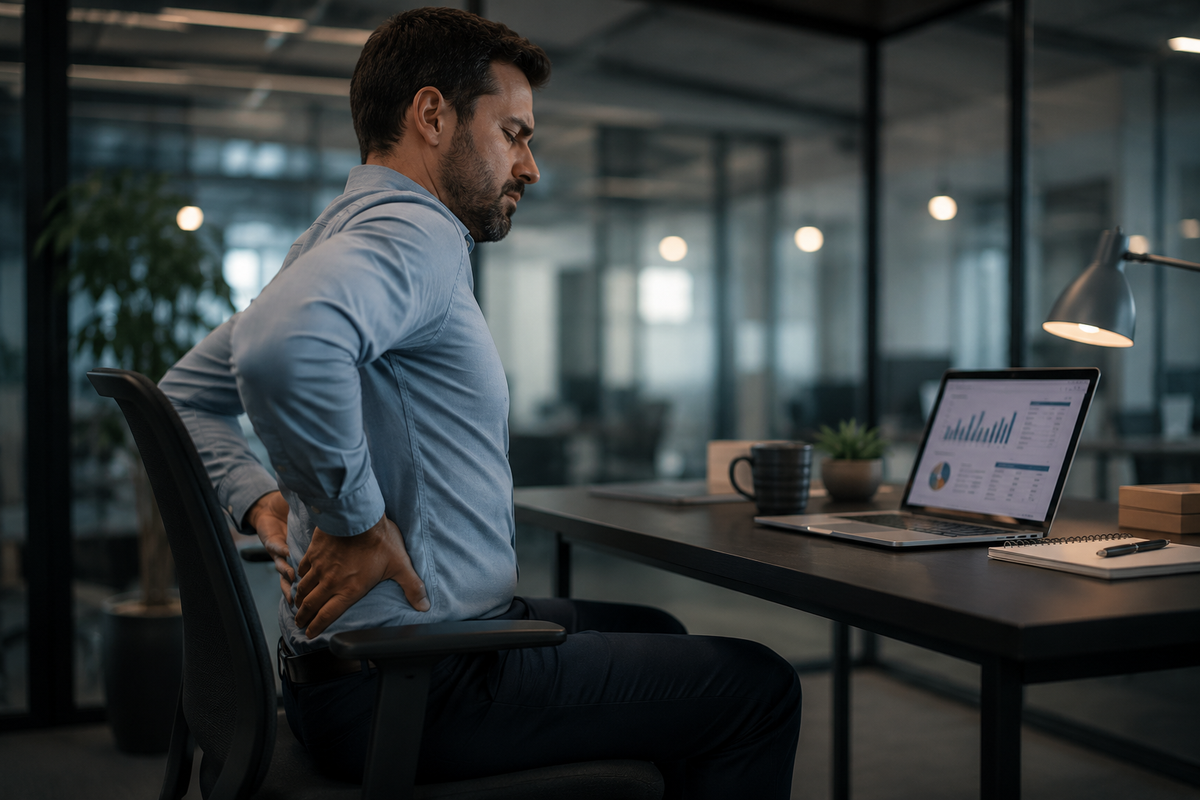
In the modern corporate landscape—particularly within the high-output corridors of Silicon Valley—we routinely demand elite cognitive performance from ourselves. We spend 8 to 12 hours a day engineering complex software architectures, managing capital, and driving high-stakes decisions from a desk.
But from a purely biomechanical standpoint, sitting is an engineering failure for the human body.
Your body is an adaptive organism. It optimizes for the positions you place it in most frequently. When you spend the majority of your waking hours in a seated position, your neural drive adapts to that specific shape. The result is a predictable cascade of structural imbalances that compromises your athletic performance, alters your posture, and ultimately accelerates physical wear.
To maintain a high-performance physical engine while scaling a career, you must understand the exact mechanical toll of the desk—and how to reverse it.
The Cascade of the Kinetic Chain
When you sit, your body enters a state of chronic compensation. This isn't just about "bad posture"; it is a systemic deactivation of your primary movers.
[Prolonged Sitting]
       │
       ▼
[Shortened Hip Flexors / Psoas] ──► [Reciprocal Inhibition of Glutes]
       │                                           │
       ▼                                           ▼
[Anterior Pelvic Tilt]                     [Glute Amnesia / Loss of Power]
       │
       ▼
[Lumbar Shear Stress & Thoracic Kyphosis ("Founder's Frame")]
1. The Shortened Lever: Hip Flexor Adaptations
In a seated position, your hips are held at a constant 90-degree angle. Over time, the tissues of your primary hip flexors—specifically the psoas major and rectus femoris—adaptively shorten. They lose their functional resting length. When you finally stand up to move, run, or squat, these tight muscles pull forward on your pelvis.
2. Glute Amnesia: Reciprocal Inhibition
Due to a neurological phenomenon known as reciprocal inhibition, when a muscle on one side of a joint is chronically tight, the nervous system automatically down-regulates the signal to the opposing muscle. Tight hip flexors tell your brain to turn off your glutes. This "glute amnesia" forces your lower back and hamstrings to take over primary extension forces during training, leading to premature injury and massive power leaks.
3. The "Founder’s Frame": Thoracic Kyphosis
The mechanical collapse doesn't stop at the pelvis. As you reach for a keyboard or lean toward a monitor, your scapulae protract, your internal rotators lock up, and your thoracic spine curves forward. This creates thoracic kyphosis—the classic slouched profile of the sedentary executive. It restricts lung volume, limits shoulder mobility, and increases shear stress on the cervical spine.
The 5-Minute Office Chair Reset
We do not fix an 8-hour structural compromise by simply grinding harder in the gym for 45 minutes on the weekend. The solution must be as consistent as the cause.
The following 3-step mobilization sequence is designed to be performed directly at your desk. It triggers immediate mechanical feedback to the nervous system, resetting your pelvic alignment and restoring thoracic extension.
              THE MYOS 5-MINUTE DESK RESET
┌────────────────────────────────────────────────────────┐
│  1. Seated Active Glute Bridge (10 Reps / Side)        │
│     -> Awakens the deactivated posterior chain.         │
├────────────────────────────────────────────────────────┤
│  2. Seated Thoracic Extension & Rotation (8 Reps)       │
│     -> Unlocks the upper spine from keyboard slouch.    │
├────────────────────────────────────────────────────────┤
│  3. Desk-Supported Psoas Decompression (60s / Side)    │
│     -> Resets pelvic tilt and opens the anterior hip.   │
└────────────────────────────────────────────────────────┘
Step 1: The Seated Active Glute Bridge (Time: 90 Seconds)
- The Target: Overcome reciprocal inhibition and reactivate the glute-medius/maximus.
- The Protocol: Sit at the very edge of your office chair with your feet flat on the ground, hip-width apart. Root your left foot firmly into the floor. Contract your left glute actively while slightly raising your right knee an inch off the ground. Hold the contraction for 3 seconds. Alternate sides for 10 controlled repetitions per side.
Step 2: Seated Thoracic Extension & Rotation (Time: 90 Seconds)
- The Target: Reverse thoracic kyphosis and open up subscapular restriction.
- The Protocol: Interlace your fingers behind your head, elbows wide. Inhale deeply, and use the top of your chair's backrest as a fulcrum to gently arch your upper back over it, looking toward the ceiling. Hold for 2 seconds. As you return to neutral, rotate your torso as far to the right as possible, then to the left. Perform 8 complete cycles.
Step 3: Desk-Supported Psoas Decompression (Time: 2 Minutes)
- The Target: Relieve anterior pelvic tilt by lengthening the shortened hip flexor complex.
- The Protocol: Stand up and place your hands on the edge of your desk for stability. Take a large step back with your right leg into a shallow lunge position. Keep your back leg completely straight and your heel off the ground. Tuck your tailbone under forcefully (posterior pelvic tilt) and squeeze your right glute. You will feel an intense, deep stretch in the front of your right hip. Hold for 60 seconds, then switch legs.
Engineering Longevity
High-resolution physical performance is built on structural integrity. If you are training on top of a compromised, misaligned skeletal frame, you are simply accelerating your path to dysfunction.
Integrate this 5-minute reset into your day every 3 hours of deep focus work. Your body is your primary asset; treat its architecture with the same precision you apply to your business operations.
Optimize Your Protocol
If you are ready to move past generic fitness templates and build a customized, data-driven strategy for your longevity and performance, our digital hybrid cohort is now accepting applications.
Whether you are local to our San Jose facility or training remotely from anywhere in the world, we design bespoke training, mobilization, and biometric tracking protocols tailored entirely to your lifestyle and biology.
Spaces are strictly capped to maintain clinical quality.
[ Apply for the Digital Hybrid Cohort at myosfitness.com]